
Free AI Visibility CheckerSee how ChatGPT, Gemini, Perplexity and Google AI talk about your brand. Free, no credit card.
Check my brandAI visibility tracking built for your market
SaaSE-commerceRetailFintech & FinanceHealthcareTravel & Hospitality

Sep 21, 2026
11 min read
Profound is the most funded tool in AI visibility, and its best features sit behind an enterprise quote. Here are seven Profound alternatives worth shortlisting in 2026, from $29 trackers to platforms built for Fortune 500 brand teams.
It depends on your budget and team. PromptRush suits teams that want five engines on every plan, including Gemini and Google AI Mode, plus Claude as an add-on, without enterprise pricing. Peec AI suits lean marketing teams that want a clean dashboard fast. AthenaHQ suits teams that want recommendations, not just tracking. Otterly.AI is the cheapest way to start.
Last updated: September 2026
Profound does a lot well. It tracks up to ten AI engines, surfaces prompt volume data, and shows how AI crawlers read your site. For a large brand with an analyst to run it, that depth is worth paying for.
The problem is getting to that depth. At the time of writing, Profound's Starter plan is $99 a month and tracks ChatGPT only. Growth is $399 a month for three engines. Claude, Gemini, Google AI Mode and the rest sit in Enterprise, which is quote-based and reported by third-party reviewers in the low-to-mid four figures a month. There is no free trial.
So most people searching for Profound alternatives are not unhappy with the product. They are priced out of the version they actually need.
Engine coverage is gated. On the self-serve plans you see ChatGPT, Perplexity and AI Overviews at most. If your buyers research in Claude or Gemini, you are blind to it until you sign an enterprise contract.
No way to test first. No free trial means you commit before you see your own data.
Reporting-first, not action-first. Profound tells you where you stand. Turning that into a content plan usually needs someone whose job is to read the dashboard.
Sales-led onboarding. Setup for full accounts is commonly reported at a few weeks, which is slow if you want a baseline before a board meeting.
PromptRush is on this list at number one. The comparison sticks to published pricing, engine coverage and features. Nobody paid for placement.
How many of the engines B2B and consumer buyers actually use (ChatGPT, Gemini, Perplexity, Claude, Google AI Overviews, Google AI Mode) you get on the plan you would realistically buy.
Whether you track your own prompts or a pre-built database. Your buyers ask specific questions, so custom prompts matter.
Mention percentages are the start. We favored tools that show which URLs the model cited, because that is what you can actually act on. The types of AI citations differ in how they drive traffic, so a blended score hides the diagnosis.
AI answers change daily. Weekly snapshots miss a lot.
A published starting price and a trial or low-cost entry plan.
We checked each tool is actively updated. This category changes monthly.
| # | Tool | Best for | Starting price | Engines on entry plan | Free trial |
|---|---|---|---|---|---|
| 1 | PromptRush | Teams that want full engine coverage at SMB pricing | From $19/mo | 5 incl. AI Mode; Claude add-on | Yes |
| 2 | Peec AI | Lean marketing teams and agencies | ~€89-95/mo | 3 of your choice | Yes |
| 3 | AthenaHQ | Teams that want action, not just data | ~$295/mo | Broad, credit-based | Discounted first month |
| 4 | Scrunch AI | Mid-market teams optimizing for AI agents | ~$250/mo | 4 | Yes |
| 5 | Otterly.AI | Solo marketers and small agencies | $29/mo | 4, add-ons for more | Yes |
| 6 | Evertune | Enterprise brand teams | Custom | Broad | Demo |
| 7 | Semrush AI Toolkit | Existing Semrush users | ~$99/mo add-on | Major engines | Via Semrush |
Read this by team size rather than rank. If you have an analyst and a five-figure budget, Profound or Evertune make sense. If you have one marketer and a quarter to show movement, the top five are a better fit. Check the "entry plan" column carefully: several tools look cheap until you add the engines you actually need.
promptrush.ai
Five engines on every plan, including Gemini and AI Mode, plus Claude as an add-on, without enterprise pricing
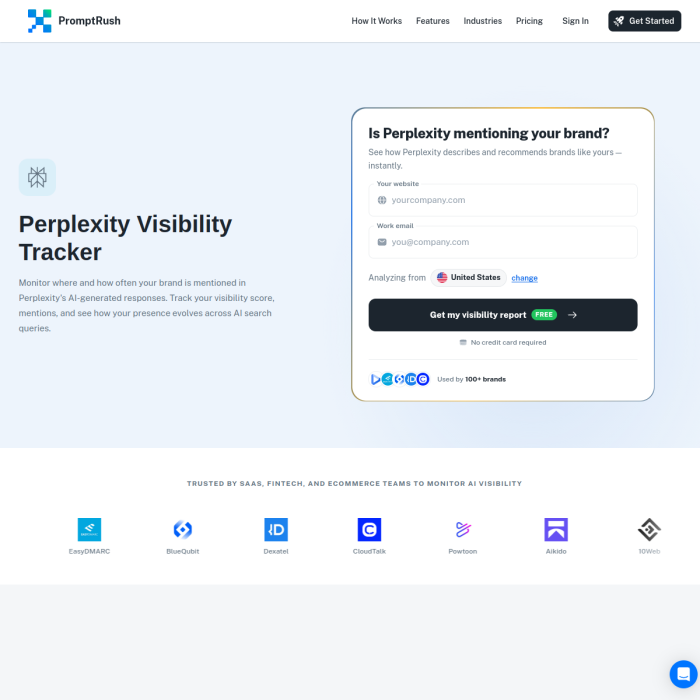
PromptRush tracks how ChatGPT, Gemini, Perplexity, Google AI Overviews, Google AI Mode and, as an add-on, Claude mention your brand, which prompts trigger those mentions, and which URLs the models cite as sources. It benchmarks you against the competitors that actually show up in your answers, not a list you guessed at sign-up.
The coverage point is the reason it is first on a Profound list. Claude, Gemini and AI Mode are exactly the engines Profound keeps inside Enterprise, and they are where a growing share of B2B vendor research happens. PromptRush includes Gemini and AI Mode on every plan and sells Claude as a $39-a-month add-on, not an enterprise contract. Reports are shaped around one question: what do we fix next. The honest limit is depth at the very top end. If you need SOC 2 paperwork, SSO and ten engines for a Fortune 500 security review, Profound is still the more complete enterprise package.
Features: Five-engine tracking (Claude as an add-on), custom prompts, cited-URL tracking, competitor share of voice, visibility score over time
Best for: SaaS, B2B and ecommerce teams that want Gemini, AI Mode and Claude without an enterprise contract, at a fraction of Profound's price. See the how it works page for the monitor, benchmark, optimize loop, or start on the ChatGPT tracker if that is the first engine you care about.
peec.ai
A clean, fast dashboard for lean marketing teams
Peec AI is the tool most often recommended to marketing teams that want answers this week rather than after a sales call. Setup takes minutes, tracking runs daily, and every plan includes unlimited seats, which is rare at this price and saves real money once the founder, the SEO lead and the content team all want to log in.
Where it trails Profound is depth, and where it trails PromptRush is coverage. Each self-serve plan lets you pick three engines, with the rest available as paid add-ons. If ChatGPT and Perplexity are all you care about, that is fine. If you want the full picture, price the add-ons before you compare headline numbers. A fuller comparison is in Peec AI alternatives.
Features: Daily tracking, visibility and sentiment scores, source analysis, competitor benchmarking, unlimited seats
Best for: Lean in-house teams and agencies that want fast, simple monitoring.
athenahq.ai
Tracking plus recommendations on what to fix
AthenaHQ is often named as the closest alternative to Profound in depth for larger organizations. It leans into what Profound users most often say is missing: turning visibility data into specific content and optimization tasks rather than leaving that step to an analyst.
The trade-off is predictability. Pricing is credit-based, which is flexible but harder to forecast month to month, and the self-serve plan is limited to one language and region. Ask how many credits a typical month of your prompt set will use before you sign.
Features: Multi-engine tracking, share of voice, content recommendations, credit-based analysis, unlimited seats
Best for: Mid-market teams that want the tool to suggest the next move, not just report the last one. See also AthenaHQ alternatives.
scrunch.com
Monitoring plus a layer that shapes how AI agents read your site
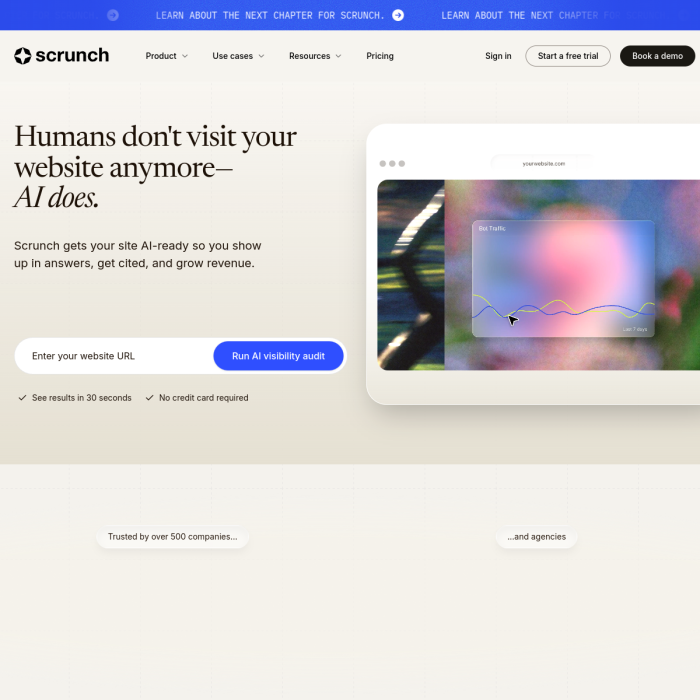
Scrunch pairs AI visibility monitoring with its Agent Experience Platform, which serves AI crawlers a version of your site built for them to read. That makes it closer to a technical layer than a pure dashboard, and more interesting than most tools here if your problem is that AI models misread your product.
The entry Core plan covers four engines and one country. Broader model coverage, API access and multiple markets sit in a custom Enterprise package, so it follows a similar pattern to Profound, just with a lower floor.
Features: Multi-engine monitoring, persona-based prompts, site audits, AI agent experience layer
Best for: Mid-market teams whose problem is how AI reads their site, not just whether it mentions them. More options in Scrunch AI alternatives.
otterly.ai
The cheapest credible way to start tracking
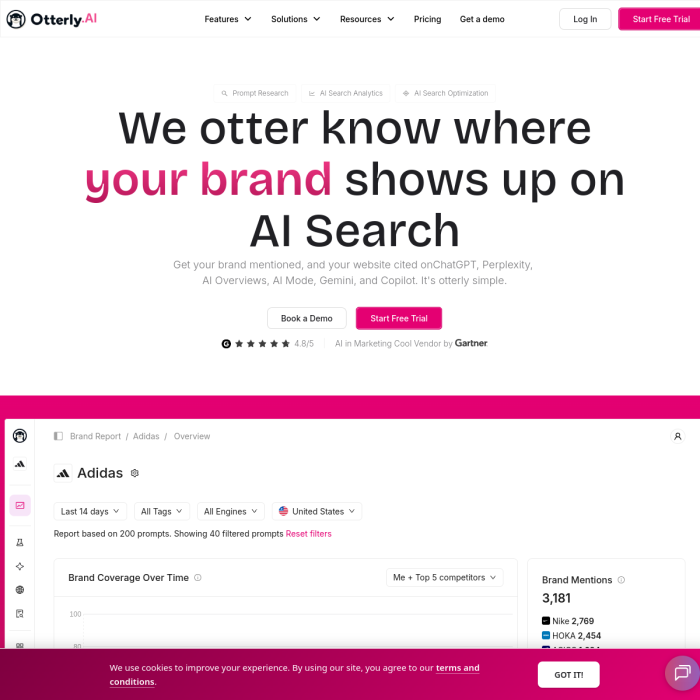
Otterly.AI is where a lot of teams start, and for good reason. The Lite plan is $29 a month, setup is simple, it has a strong G2 record and it was named a Gartner Cool Vendor in 2025. It also includes a GEO audit that checks on-page factors, which is a useful first to-do list.
The limits show up as you grow. Lite covers 15 prompts, Standard jumps to $189 for 100, and AI Mode and Gemini cost extra on every plan. It is a great way to find out whether AI mentions you at all. Most teams outgrow it once they need citation detail across every engine. See Otterly.AI alternatives if that is already happening.
Features: Brand and link monitoring, GEO audit, sentiment tracking, unlimited team members
Best for: Solo marketers and small agencies testing AI visibility on a tight budget.
evertune.ai
Enterprise brand analytics built on large-scale sampling
Evertune is aimed at the same buyer as Profound Enterprise: brand and marketing leaders at large companies. Its angle is statistical depth, running prompts at a scale that makes the results hold up in a boardroom rather than looking like a handful of screenshots.
If you are leaving Profound because of price, Evertune is not your answer. If you are leaving because you want a second enterprise option to negotiate against, it is worth the demo.
Features: Large-scale prompt sampling, brand perception analytics, competitive benchmarking
Best for: Enterprise brand teams comparing premium platforms.
semrush.com
The easy add-on if you already live in Semrush
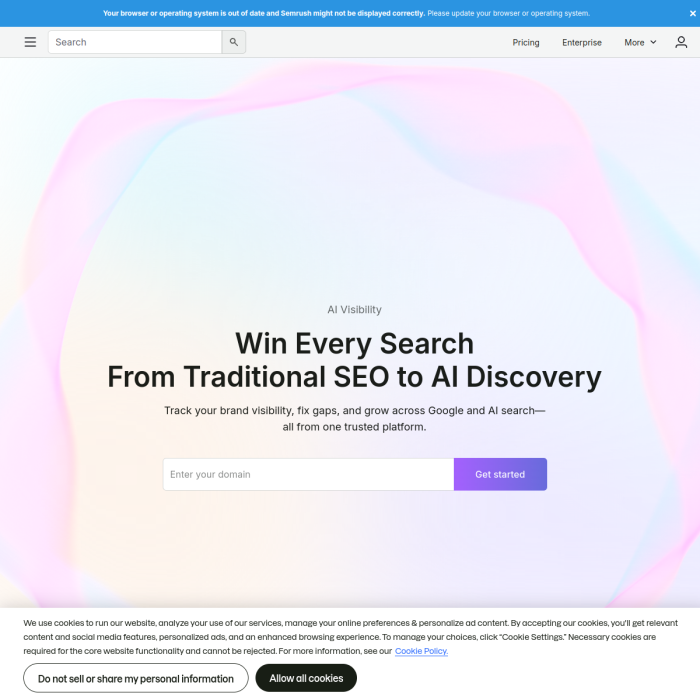
If your SEO team already pays for Semrush, the AI Toolkit puts AI visibility next to the keyword and backlink data you use every day. No new vendor, no new login, no procurement review.
It is an add-on to an SEO suite rather than a dedicated AI visibility product, so depth on prompts and citations is thinner than the specialists above. For many teams that is an acceptable trade for convenience.
Features: AI visibility and sentiment, brand perception insights, integration with Semrush SEO data
Best for: SEO teams already on Semrush that want AI data in the same place.
List where your buyers research. B2B software buyers lean on ChatGPT, Claude and Perplexity. Consumer and local searches lean on Google AI Overviews and AI Mode. Then check whether those engines are on the plan you would buy, not the plan in the headline.
AI answers shift day to day. Ask how often each prompt runs on each engine, and whether one bad day can swing your score.
A visibility score tells you there is a problem. The list of URLs the model cited tells you where to fix it: your own pages, a review site, a listicle, a Reddit thread.
Tools that only use a pre-built prompt database are useful for market-wide share of voice but miss the specific questions your buyers ask. Make sure you can add your own.
If nobody on your team owns AI visibility, pick a tool that recommends actions or comes with people who can run them. A dashboard nobody opens is the most expensive plan of all.
At the time of writing, entry-level AI visibility tools run from roughly $20 to $100 a month, mid-market platforms from $250 to $500, and enterprise contracts from the low thousands a month upward. Profound itself spans all three bands: $99 for ChatGPT only, $399 for three engines, and custom pricing for everything else.
The headline number is rarely the real number. Before you compare, ask each vendor what it costs to track your actual prompt count across the engines you need, with daily sampling, for every seat that needs access. Two tools with the same list price can differ by a factor of three once add-ons are included.
What to verify: prices in this category move monthly. Confirm PromptRush entry price and engine list, Profound's $99/$399 tiers, Peec's entry price, AthenaHQ around $295, Scrunch around $250, Otterly at $29, and the Semrush $99 add-on before you buy.
Run your brand through PromptRush and get a baseline across all five engines: how often you are mentioned, which competitors show up instead, and which URLs AI models cite in your category. Start tracking with PromptRush.
For enterprise brands with an analyst to run it and a real compliance requirement, yes. For startups and lean teams, the self-serve plans cover too few engines to justify the price, and the full product needs an enterprise contract.
Otterly.AI starts at $29 a month and PromptRush from $19. Both let you start tracking without a sales call.
At the time of writing, Claude and Gemini are only available on Profound's Enterprise plan. PromptRush offers Claude as an add-on on any paid plan, from $39 a month.
Profound goes deeper at enterprise scale with more engines, compliance certifications and agent analytics. PromptRush covers the five engines most teams need, including Gemini and AI Mode, plus Claude as an add-on, at a price a startup can approve without procurement. Current plans are on the pricing page.
Partly. You can run prompts manually in each assistant, and some tools offer free one-off checks. For daily tracking across several engines you will need a paid tool, but most alternatives here offer a trial.
Daily is the practical standard. AI answers change often enough that weekly sampling can miss a competitor overtaking you for days at a time.
Co-Founder & CEO, PromptRush
Rafayel Begoyan is the Co-Founder and CEO of PromptRush. With over a decade of experience in SEO, spanning technical audits, international SEO, content strategy, and organic growth, he now focuses on the intersection of search optimization and AI visibility. Rafayel writes about how brands can adapt to generative search and get discovered in an AI-first world.
View profileGet a free AI visibility report across ChatGPT, Gemini, Perplexity, AI Overviews, and AI Mode. We scan your site and email the results.
Get my visibility reportNo sign-up or credit card required