
Apr 27, 2026
11 min read
Have you noticed that more and more often, you search for something and get a full answer from AI instead of a list of links? And in that answer, a few brands or tools are mentioned as recommendations.
The question is no longer just "How do I rank on Google?" but "How do I get mentioned by AI?"
So, what is generative engine optimization? Generative Engine Optimization, or GEO, is a way of creating and structuring content so AI tools can understand it, trust it, and use it when they generate answers. Unlike traditional SEO, where the goal is to rank higher on a search results page, GEO focuses on helping your brand appear inside AI-generated responses. This means your content needs to be clear, well-structured, and supported by trustworthy signals across the web, so AI engines see it as a reliable source worth mentioning.
This shift is starting to change how we think about content, SEO, and online visibility.
To better understand GEO marketing, it helps to look at how search behavior is changing. Traditional SEO is based on rankings. You try to get your page to the top of search results so people click and visit your website. Generative AI changes that flow. Instead of showing a list of links, AI tools generate a direct answer and mention only a few sources. In many cases, the user gets what they need without ever opening a website.
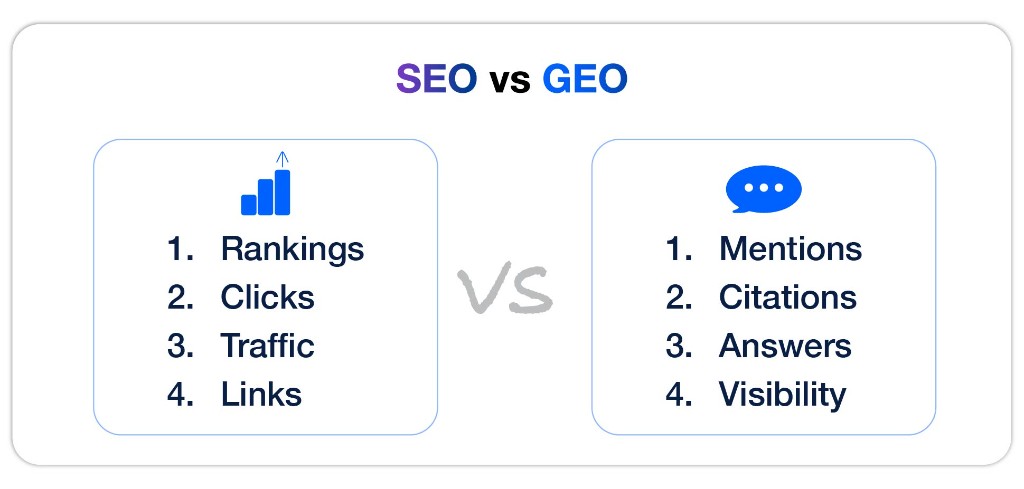
This changes the goal of optimization. Traditional SEO helps you rank and get traffic. GEO helps your brand appear inside AI-generated answers. Generative engines don't just look at keywords and backlinks. They look for quality content, reliable sources, and brands that are consistently mentioned across the web. SEO still matters because it helps your content get discovered, but now there is another layer of visibility to think about, and that layer is AI.
When someone asks a question, the AI doesn't just search for one page and show it as a result. Instead, it scans many sources, selects the most relevant and trustworthy information, and then generates a new answer based on what it finds. In many cases, it will also mention or cite the sources it used to build that answer.
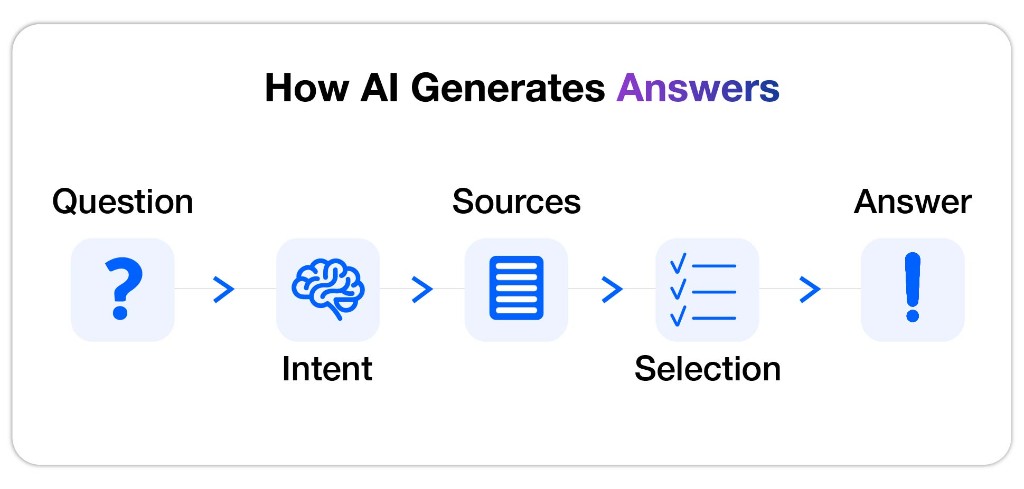
This process usually happens in a few steps. First, the AI tries to understand the intent behind the question. Then it retrieves content from different sources such as websites, articles, forums, and databases. After that, it selects the information that looks the most reliable and relevant, summarizes it, and turns it into an answer. During this process, certain brands, tools, or websites may be mentioned as examples, recommendations, or sources.
Those citations take several forms — in-text links, inline chips, source cards, and rich cards — which carry very different visibility value. The guide to the types of AI citations explains each format across ChatGPT, Perplexity, Gemini, Copilot, and Google.
This is exactly why structure and clarity matter so much. Generative engines prefer content that is easy to understand, easy to summarize, and easy to quote. Clear explanations, structured sections, bullet points, definitions, and data all make it easier for AI to extract information and reuse it in answers.
By now, it's clear that appearing in AI answers doesn't happen by accident. There are certain signals that generative engines look for when they decide which sources to use and which brands to mention. In many ways, this is what geo marketing really is; building a strong, clear, and trustworthy presence that AI engines can recognize and confidently include in their answers.
Let's look at the five principles that make content easier for AI engines to find, understand, and use.
Even though AI search is changing how people find information, traditional SEO still plays an important role. Generative engines often pull information from pages that already perform well in organic search, which means your website still needs to be technically sound, well-structured, and properly indexed.
This includes clear site structure, relevant keywords, strong internal linking, and backlinks from trustworthy websites. In simple terms, if search engines can't easily find and understand your content, AI engines probably won't find it either.
Generative engines don't just read pages, they try to understand entities. An entity can be a company, a product, a person, or a brand. The clearer your brand identity is across the internet, the easier it is for AI to understand who you are and what you do.
This means your brand description, product description, and positioning should be consistent across your website, LinkedIn, directories, press mentions, and other platforms. When AI sees the same clear description of your brand in multiple places, it becomes more confident including your brand in its answers.
AI engines prefer content that is easy to read, easy to understand, and easy to reuse in an answer. This is why structure matters so much. Clear headings, short paragraphs, bullet points, definitions, tables, and step-by-step explanations make it easier for AI to extract information from your content.
If a paragraph is too long, too vague, or too complicated, it's harder for AI to use it. But if your content clearly answers a question or explains a concept, there's a much higher chance that AI will reuse that information in its response.
One of the biggest differences between SEO and GEO is that AI engines don't rely only on your website. They look at information across the entire internet, including articles, reviews, forums, social media, directories, research papers, and industry websites.
This means your brand needs to be visible in multiple places, not just on your own site. Mentions, reviews, guest articles, interviews, and PR all help build a stronger presence across the web, especially in competitive spaces like SaaS, where visibility across multiple platforms plays a big role in how brands get recognized and mentioned in AI-generated answers.
In traditional SEO, success is usually measured by rankings, traffic, and clicks. In AI search, visibility is measured differently. What matters more now is how often your brand is mentioned in AI answers, how you are described, and how often you appear compared to your competitors.
This is why tracking AI visibility is becoming important. Instead of only tracking keyword rankings, companies are starting to track brand mentions, citations, and presence across AI-generated answers. This way, they can understand how visible they really are in AI search.
Once you start investing in GEO, you need a way to measure progress. Rankings and traffic still matter, but they don't show the full picture anymore. It's also important to understand how often your brand appears in AI-generated answers, which topics you are associated with, and how your visibility compares to other brands in your space.
Some teams try to track this manually by testing prompts and recording which brands appear in the answers, but this quickly becomes difficult to manage as the number of prompts grows. Tools like PromptRush help solve this problem by tracking brand mentions, visibility, and positioning across AI platforms. For example, a ChatGPT Tracker can show how often your brand appears in AI-generated answers and how that visibility changes over time, and a Perplexity Visibility Tracker does the same for citations and mentions inside Perplexity answers — see the guide to ranking on Perplexity for the platform-specific playbook.
As AI search continues to grow, this type of tracking is becoming an important part of understanding overall search performance, not just in traditional search engines, but across AI search environments as well.
At this point, the big question becomes practical: what actually helps content appear in AI answers? While there is no single trick that guarantees visibility, there are clear patterns. AI engines tend to select content that is easy to understand, clearly written, well-structured, and supported by strong signals across the web. The strategies below can significantly improve your chances of being included in AI-generated responses.
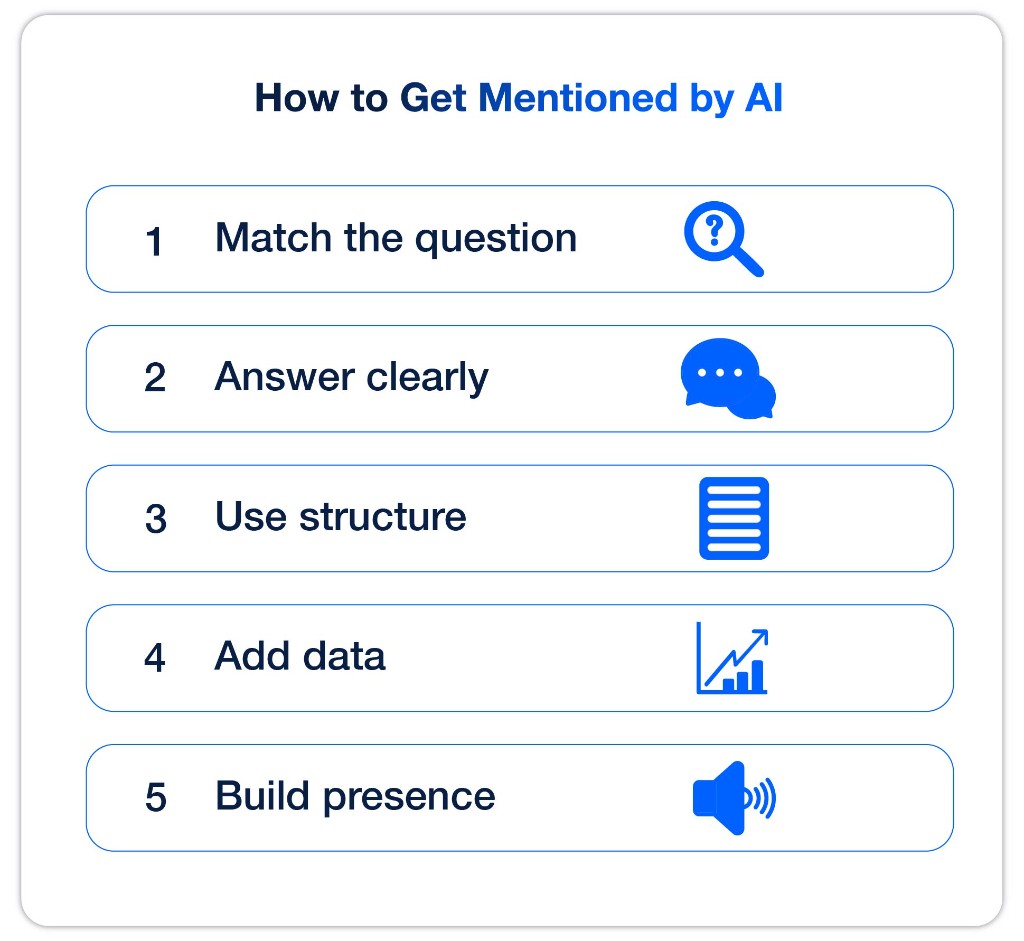
One of the most important factors is how closely your content matches the user's question. AI engines look for content that directly answers the query in clear language. This means your headings and paragraphs should closely match the way people actually search and ask questions.
Long-tail keywords, question-based headings, and very clear topic focus help a lot here. Instead of writing very general content, it's often more effective to create pages that answer specific questions clearly and directly.
Generative engines prefer content that is easy to extract and reuse in an answer. Pages that include clear definitions, short explanations, step-by-step instructions, and bullet points are much easier for AI to summarize and include in responses.
If a section of your content clearly answers a question in a structured way, there is a higher chance that AI will reuse that part when generating an answer. FAQ sections, how-to content, and structured explanations often perform well in generative search.
Even though AI search works differently, traditional search visibility still matters. Many AI systems still rely on top-ranking pages as one of their main information sources. If your content already performs well in organic search, it has a higher chance of being selected and used by generative engines.
Local search can also play a role, especially for location-based questions. Businesses that are well-optimized for local SEO often appear in AI answers for local recommendations and services.
AI engines often prefer content that includes original data, statistics, research, or unique insights. If your website publishes reports, case studies, surveys, or industry data, other websites may cite you, and AI engines may start using your data as a source.
Being a source is very powerful in generative search. Instead of just repeating information, you become one of the places where information comes from.
AI engines don't just look at your website, they also look at how your brand is described across the internet. Articles, interviews, reviews, and mentions on other websites all help shape how AI understands your brand.
If your brand is consistently mentioned in relevant articles, industry websites, and discussions, AI engines are more likely to recognize your brand as a known and trustworthy source. Over time, this increases the chances of your brand being mentioned in AI-generated answers.
One of the biggest misconceptions is that GEO is just about adding AI-related keywords to your content. In reality, Generative Engine Optimization is more about clarity, structure, and credibility. AI engines are trying to find reliable sources and clear answers, not just pages that repeat certain keywords.
No, GEO is not replacing SEO. The two work together. SEO helps your content get discovered and indexed, while GEO helps your content get selected and used in AI-generated answers. Companies that combine both are usually in a much stronger position than those that focus on only one.
Search is moving from lists of links to direct answers, and this is changing how brands become visible online. In this context, geo marketing becomes a visibility strategy, not just a technical task. It includes content, brand positioning, PR, and overall online presence, all working together to help your brand appear in AI-generated answers.
Many people ask what generative SEO is and what kind of content works best for it. In most cases, content that clearly explains a topic, answers specific questions, includes structured sections, and provides useful data performs well. Guides, how-to articles, research, definitions, and comparison pages are often easier for AI engines to understand and reuse in their answers.
Large brands often appear more frequently because they are mentioned across many websites and already have strong authority. However, smaller brands can still appear in AI answers if they create clear, helpful content and build a consistent presence across different platforms.
If you're still wondering what GEO stands for, the simplest way to think about it is this: GEO helps AI engines understand your brand, trust your content, and include you in their answers. Companies should start thinking not only about rankings, but also about how their brand appears in AI-generated responses.
Co-Founder & CEO, PromptRush
Rafayel Begoyan is the Co-Founder and CEO of PromptRush. With over a decade of experience in SEO, spanning technical audits, international SEO, content strategy, and organic growth, he now focuses on the intersection of search optimization and AI visibility. Rafayel writes about how brands can adapt to generative search and get discovered in an AI-first world.
View profileGet a free AI visibility report across ChatGPT, Gemini, Perplexity, AI Overviews, and AI Mode. We scan your site and email the results.
Get my visibility reportNo sign-up or credit card required