
Free AI Visibility CheckerSee how ChatGPT, Gemini, Perplexity and Google AI talk about your brand. Free, no credit card.
Check my brandAI visibility tracking built for your market
SaaSE-commerceRetailFintech & FinanceHealthcareTravel & Hospitality

Sep 21, 2026
11 min read
Peec AI is one of the best-liked tools in AI visibility, and most people looking for alternatives are not unhappy with it. They have hit the three-engine limit or the prompt cap. Here are seven Peec AI alternatives worth shortlisting in 2026.
It depends on what you have outgrown. PromptRush suits teams that want five engines, including Gemini and AI Mode, without picking three, plus Claude as an add-on. Otterly.AI suits teams that want to spend less. Profound suits enterprise brands that need depth and compliance. Rankscale is the cheapest way to cover a lot of engines.
Last updated: September 2026
Peec earned its reputation. Setup takes minutes, tracking is daily on every plan, the interface is clean, and unlimited seats mean the whole team can log in without a budget conversation. It has grown fast and raised serious funding, which is usually a sign a product is doing something right.
The friction comes from how the plans are built. Each self-serve tier includes three engines of your choice from six, with a fourth available as a paid add-on. At the time of writing, the entry plan sits around €89-95 a month for a limited prompt set, and moving up in prompts means moving up a full tier.
So the question most Peec users are really asking is not "is there a better tool" but "is there a tool that covers what I need without the add-ons."
Three engines per plan. You choose three of ChatGPT, Perplexity, Gemini, Google AI Overviews, Google AI Mode and Copilot. Covering them all means paying for add-ons, which erodes the value story.
Claude coverage. Claude is increasingly where B2B buyers research software. Check whether it is available on the plan you would buy.
Prompt caps scale by tier. Growing from a starter prompt set to a real one means a jump in plan, not a small increment.
Monitoring, not strategy. Several reviews describe Peec as a visibility tracker rather than a strategy tool. It shows where you stand, with less guidance on what to change.
PromptRush is on this list at number one. The comparison sticks to published pricing, engine coverage and features. Nobody paid for placement.
Which of the engines your buyers use are included on the plan, and which cost extra.
The price of tracking your realistic prompt count across the engines you need, not the headline.
We favored tools that show which URLs the model cited, because that is where the work happens.
Daily tracking is the bar Peec sets. We did not reward tools that fall below it without saying so.
Peec's unlimited seats are a genuine advantage. We note where alternatives charge per user.
Actively updated tools only.
| # | Tool | Best for | Starting price | Engines on entry plan | Free trial |
|---|---|---|---|---|---|
| 1 | PromptRush | Five engines without picking three | From $19/mo | 5 incl. AI Mode; Claude add-on | Yes |
| 2 | Otterly.AI | Budget teams and small agencies | $29/mo | 4, add-ons for more | Yes |
| 3 | Profound | Enterprise brands | $99/mo (ChatGPT only) | 1 on Starter | No |
| 4 | AthenaHQ | Teams that want action, not just data | ~$295/mo | Broad, credit-based | Discounted first month |
| 5 | Scrunch AI | Mid-market teams optimizing for AI agents | ~$250/mo | 4 | Yes |
| 6 | Rankscale | Lowest-cost broad coverage | ~€20/mo | Many, credit-based | Yes |
| 7 | Ahrefs Brand Radar | Existing Ahrefs users | Add-on to Ahrefs | Major engines | Via Ahrefs |
The pattern to notice: almost every tool here, Peec included, has a cheap headline plan and a real plan. Compare on the real plan. If you need five or six engines and a hundred-plus prompts, the price order in this table changes a lot.
promptrush.ai
Five engines on every plan, including Gemini and AI Mode, plus Claude as an add-on
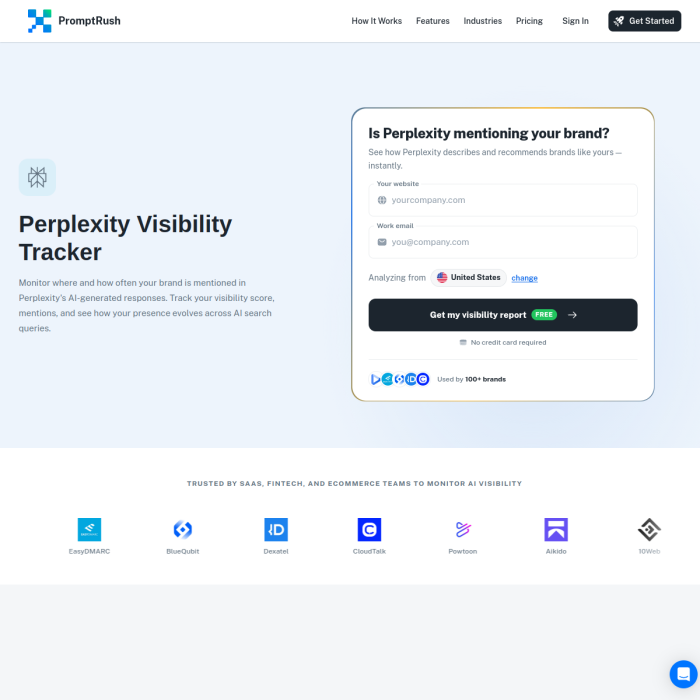
PromptRush tracks how five major engines, plus Claude as an add-on, mention your brand, which prompts trigger those mentions, and which URLs each model cites. You set your own prompts and see your share of voice against the competitors that actually appear in your answers.
For a Peec user, the difference is simple: you do not pick three engines. Gemini and Google AI Mode are included alongside ChatGPT, Perplexity and AI Overviews on every plan, and Claude is available as an add-on from $39 a month. Reports lean toward "what to fix next" rather than a score on its own. Where Peec is still ahead is polish and team scale: its unlimited seats and mature interface are hard to beat for a large marketing team.
Features: Five-engine tracking (Claude as an add-on), custom prompts, cited-URL tracking, competitor share of voice, visibility trends
Best for: Teams that have outgrown three engines and want Gemini and AI Mode without add-on pricing. The LLM SEO tool overview covers how tracking feeds optimization work.
otterly.ai
A lower entry price and a built-in GEO audit
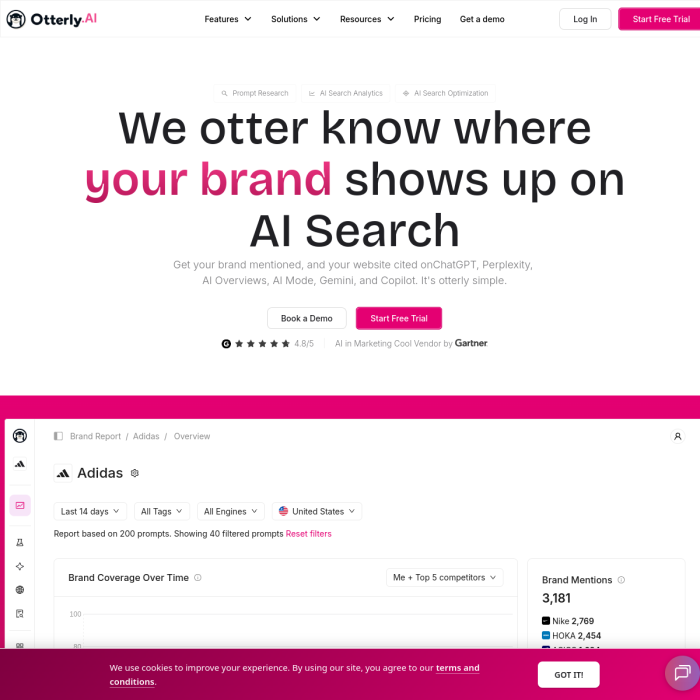
Otterly.AI is the most common budget alternative to Peec. The Lite plan is $29 a month, unlimited team members are included, and the GEO audit gives you an on-page checklist that Peec does not. It was named a Gartner Cool Vendor in 2025 and has a strong review record.
It shares Peec's structural issue, though. AI Mode and Gemini are add-ons on every plan, Lite covers only 15 prompts, and Standard jumps to $189. Price it with the engines you need before assuming it is cheaper.
Features: Brand and link monitoring, GEO audit, sentiment tracking, unlimited team members
Best for: Solo marketers and small agencies that want to spend less than Peec.
tryprofound.com
Enterprise depth, compliance and prompt volume data
Profound is the move up, not the move sideways. It covers up to ten engines on Enterprise, adds prompt volume data showing what people ask AI in your category, tracks how AI crawlers use your site, and carries the SOC 2 and SSO paperwork a large company's security team will ask for.
Do not compare its entry plan to Peec's. Starter tracks ChatGPT only, Growth is $399 for three engines, and the full product is quote-based. If you are leaving Peec to save money, Profound is the wrong direction. If you are leaving because you need more depth and have the budget, it is the obvious shortlist. See Profound alternatives for the other side of that comparison.
Features: Up to 10 engines (Enterprise), prompt volumes, agent analytics, SOC 2, SSO
Best for: Enterprise brands with an analyst and a compliance requirement.
athenahq.ai
Recommendations on what to fix, not just tracking
AthenaHQ targets exactly the gap reviewers point to in Peec: it turns visibility data into content and optimization tasks. Engine coverage is broad and seats are unlimited, so it keeps one of Peec's best features.
It costs roughly three times Peec's entry plan, and the credit-based model makes monthly spend harder to predict. Worth it if you want the tool to act as a strategist. Overkill if you only need monitoring.
Features: Multi-engine tracking, share of voice, content recommendations, unlimited seats
Best for: Teams that want guidance, not just a visibility score.
scrunch.com
Monitoring plus a layer for how AI agents read your site
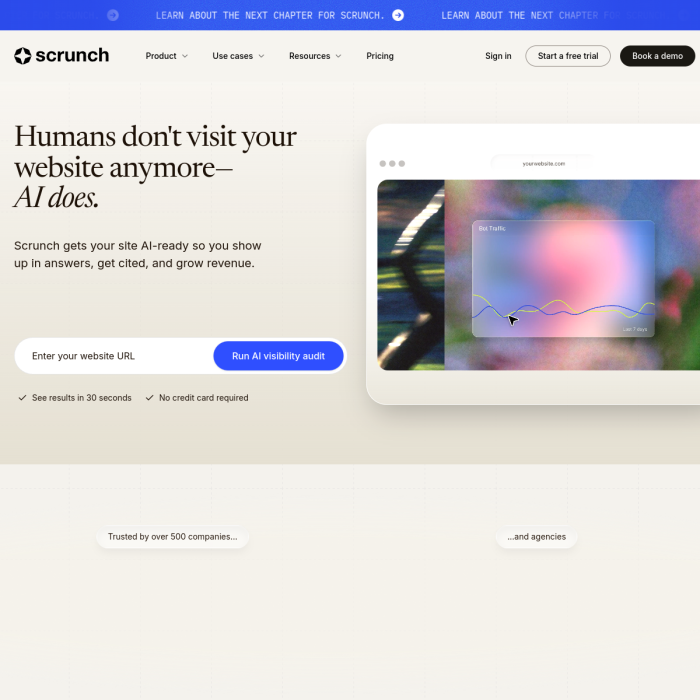
Scrunch combines monitoring with its Agent Experience Platform, which gives AI crawlers a version of your site built for machines to read. It also runs persona-based prompts, which helps if different buyer types ask very different questions.
The Core plan covers four engines and one country, with broader coverage and API access in Enterprise. It is a step up in price from Peec and a step toward technical optimization rather than reporting.
Features: Multi-engine monitoring, persona prompts, site audits, AI agent experience layer
Best for: Mid-market teams whose issue is how AI understands their site.
rankscale.ai
The cheapest way to cover a lot of engines
Rankscale is the budget pick for teams that care about breadth. It covers a long list of AI engines on a credit-based model, starts around €20 a month, and ships new features quickly.
Credits make cost less predictable as your prompt set grows, and as a smaller company, support depth can vary. For a founder who wants broad coverage on a small budget, it is a strong option.
Features: Broad engine coverage, credit-based tracking, exports, competitor tracking
Best for: Founders and small teams that want wide coverage for very little.
ahrefs.com
Market-wide share of voice from a huge prompt database
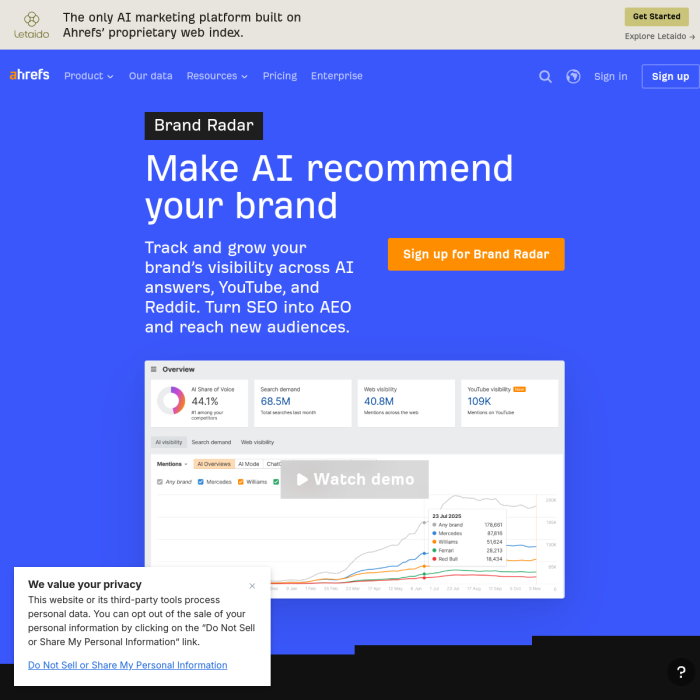
Brand Radar works differently from Peec. Instead of starting with your prompts, it draws on a very large database of prompts built from real search data, which makes it strong for seeing your share of voice across a whole category.
The flip side is less control over tracking the exact questions your buyers ask. It works best alongside a custom-prompt tracker, or for teams already paying for Ahrefs who want a market view without another vendor.
Features: Large prompt database, share of voice, cited domains and pages, integration with Ahrefs SEO data
Best for: Ahrefs users who want category-wide AI visibility data.
Write down where your buyers research, then price every tool with those engines included. This single step changes the ranking more than anything else.
Most teams start with 25 to 50 prompts and end up needing 100 to 300 once they cover products, use cases and competitors. Price for where you will be in three months.
Peec runs daily. Anything weekly will feel like a downgrade.
If five people need access, per-seat pricing can quietly double your bill. Peec's unlimited seats set a high bar here.
If your team knows what to do with a visibility report, a tracker is enough. If not, pick a tool that recommends actions, or one backed by a team that can run them.
At the time of writing, the budget end of this market runs from about €20 to $100 a month, mid-market tools from $250 to $500, and enterprise platforms from the low thousands upward. Peec's entry plan sits near the top of the budget band.
The number that matters is the cost to track your real prompt set across your real engine list, daily, for every seat. Run that calculation for Peec and for any alternative before comparing. It is common for a tool with a lower headline price to end up more expensive once add-ons are included, and the reverse.
What to verify: Peec entry price (sources show €89-95) and add-on engine cost; Otterly $29/$189; Profound $99/$399; AthenaHQ around $295; Scrunch around $250; Rankscale around €20; Ahrefs Brand Radar add-on pricing.
Run your brand through PromptRush and get a baseline across ChatGPT, Gemini, Perplexity, Google AI Overviews and AI Mode: how often you are mentioned, who shows up instead, and which URLs get cited. Start tracking with PromptRush.
For lean teams that care about two or three engines, yes. It is fast, clean and includes unlimited seats. It gets expensive once you need all six engines and a larger prompt set.
Rankscale starts around €20 a month, PromptRush from $19 and Otterly.AI at $29. Check each with the engines you need included.
Check Peec's current pricing page. At the time of writing, its six standard engine options are ChatGPT, Perplexity, Gemini, Google AI Overviews, Google AI Mode and Copilot. PromptRush offers Claude as an add-on on any paid plan, from $39 a month.
Peec has the more mature interface and unlimited seats. PromptRush includes five engines on every plan, including Gemini and AI Mode, offers Claude as an add-on, and shows cited URLs for every answer.
Peec wins on value and simplicity. Profound wins on depth, engine count and compliance, but only on its Enterprise plan.
Daily. AI answers change often enough that weekly snapshots miss real shifts.
Co-Founder & CEO, PromptRush
Rafayel Begoyan is the Co-Founder and CEO of PromptRush. With over a decade of experience in SEO, spanning technical audits, international SEO, content strategy, and organic growth, he now focuses on the intersection of search optimization and AI visibility. Rafayel writes about how brands can adapt to generative search and get discovered in an AI-first world.
View profileGet a free AI visibility report across ChatGPT, Gemini, Perplexity, AI Overviews, and AI Mode. We scan your site and email the results.
Get my visibility reportNo sign-up or credit card required