
Apr 28, 2026
9 min read
Ranking on Perplexity is not the same as ranking on Google. There is no list of ten blue links to climb. Instead, Perplexity returns a single synthesized answer with a small set of cited sources, and the goal is to be one of those sources — or to be named inside the answer itself.
That changes what optimization looks like. Keyword position matters less. Citation eligibility, topical authority, and how clearly your content answers a question matter more. This guide explains how Perplexity selects sources, the two types of citations to monitor, the levers that move visibility, and how to track results across markets so the work compounds.
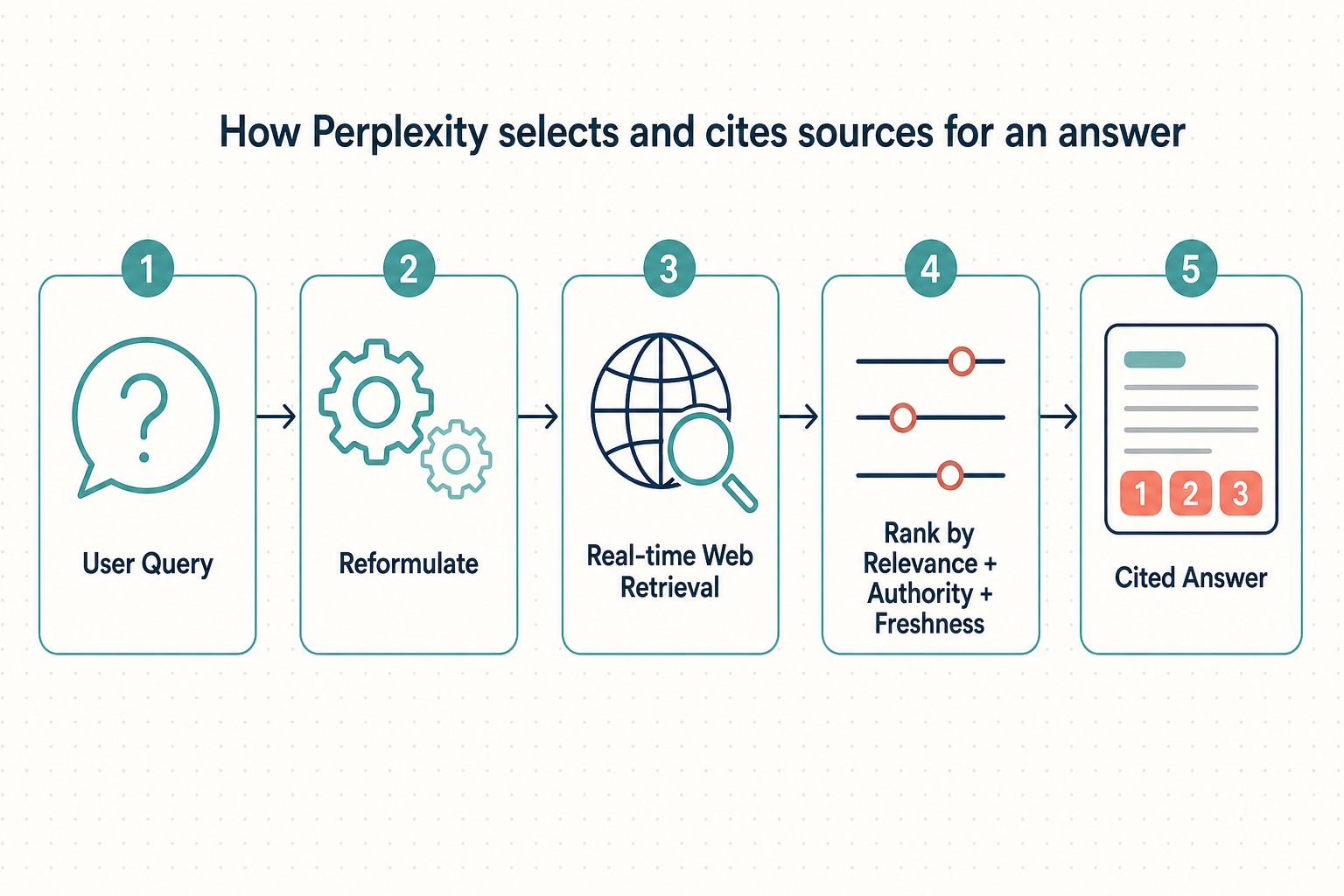
Perplexity is an answer engine built on large language models combined with a real-time web retrieval layer. When a user submits a query, the system reformulates the question, searches the live web, pulls candidate sources, and uses the language model to synthesize a direct answer. The sources that informed that answer are surfaced as numbered citation cards.
Three signals carry most of the weight in source selection. The first is relevance: how directly the page answers the underlying question, not just how often the keyword appears. The second is authority: a mix of domain reputation, third-party mentions, and topical depth on the subject. The third is freshness: Perplexity gives meaningful preference to recently published or recently updated content, especially on fast-moving topics like software, finance, and AI.
The output of that process is a short list of cited sources — usually three to eight — plus an answer body that may name additional brands, products, or organizations without linking to them. Both forms of presence count as visibility, and both are worth optimizing for.
The practical implication is that ranking on Perplexity is less about chasing a position and more about being chosen as a credible source. Every recommendation in this guide flows from that.
Perplexity surfaces brands in two distinct ways inside an answer. Treating them as the same thing is one of the most common measurement mistakes. Perplexity relies heavily on numbered citations and source cards, but those formats appear on other AI platforms too — see the guide to the types of AI citations for a full breakdown across ChatGPT, Gemini, Copilot, and Google.
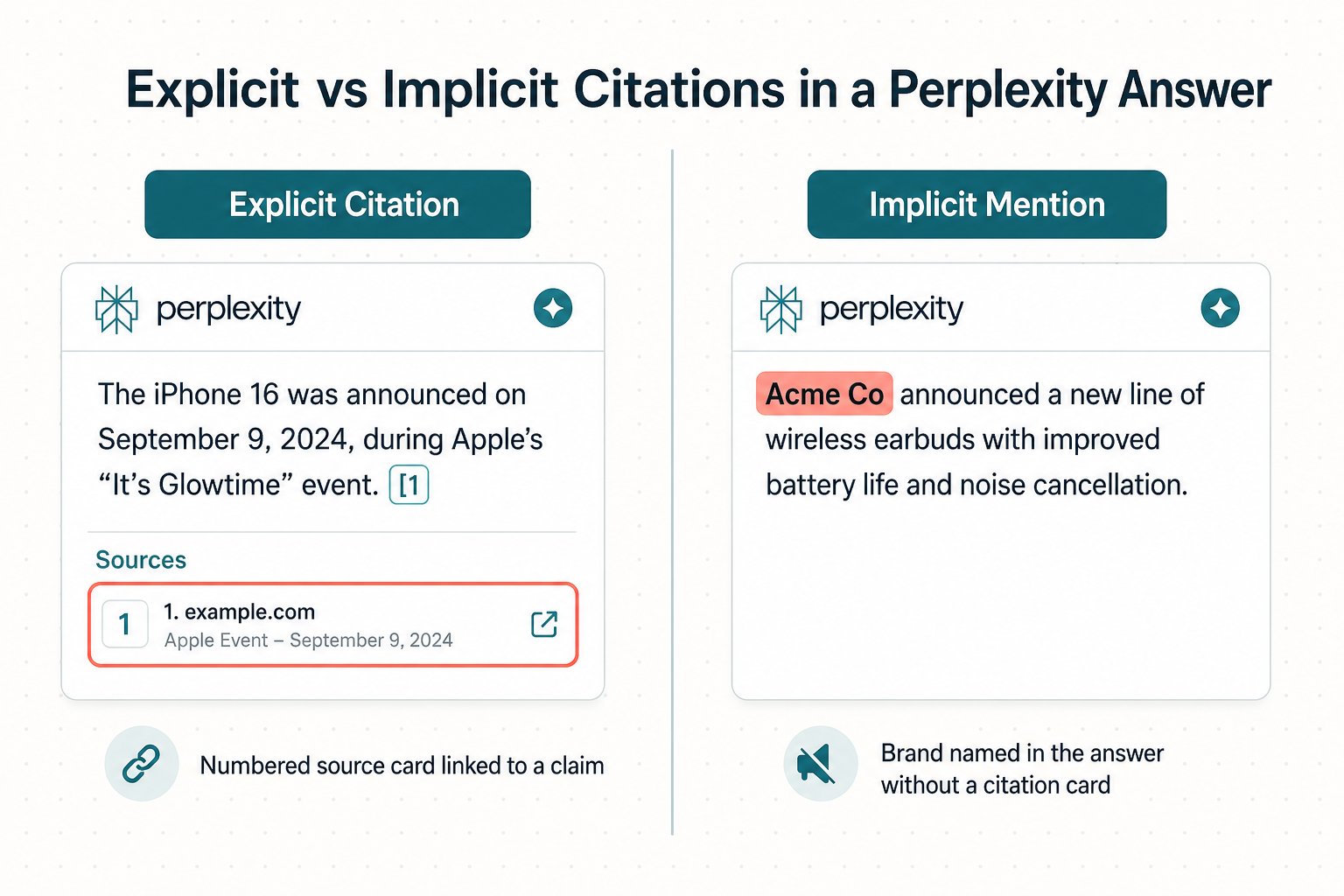
An explicit citation is a numbered source card attached to a specific claim in the answer. It links out to the cited page and tells the user "this is where this part of the answer came from." Explicit citations drive referral traffic, signal credibility, and put your domain directly in front of the reader.
An implicit mention is when your brand, product, or organization is named inside the answer text without being one of the numbered sources. The user sees the name as part of the recommendation or context but does not click through directly. Implicit mentions still shape perception, drive branded follow-up searches, and influence which option the reader evaluates next.
Explicit citations are easier to count, and most third-party tools focus there. But implicit mentions often outnumber explicit citations for established brands and tell a different story about how Perplexity perceives a category. A complete view of Perplexity visibility tracks both, separately, so you know whether you are winning on direct citations, on brand recall inside answers, or both.
The word "rank" carries Google baggage. On Perplexity, position 1 to 10 is the wrong frame. A useful Perplexity visibility model has four core metrics.
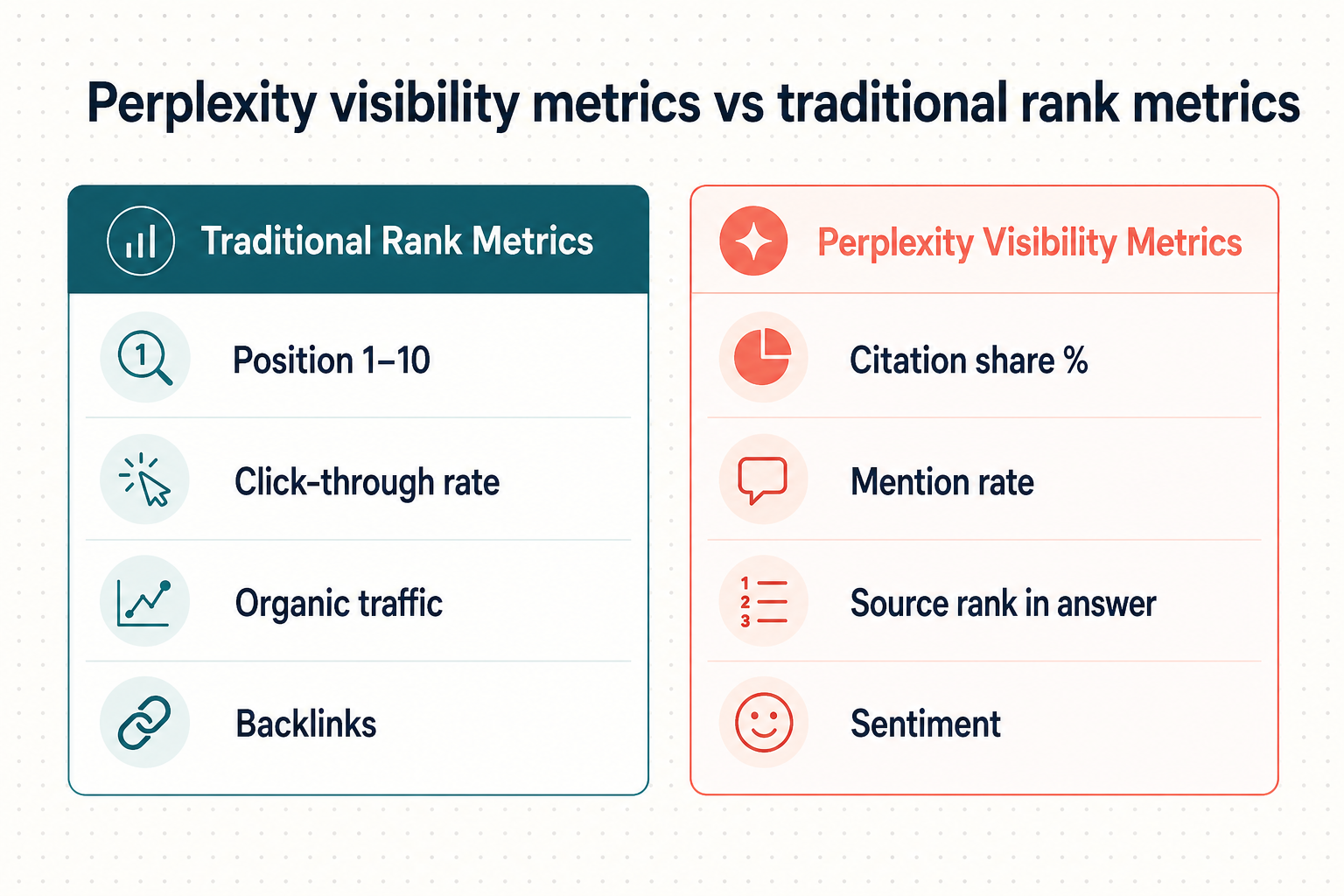
Citation share is the percentage of tracked queries where your domain appears as an explicit citation. Mention rate is the percentage of tracked queries where your brand is named in the answer text, with or without a citation. Source rank is your average position within the citation card list — being source 1 is more valuable than being source 7. Sentiment is whether the surrounding answer text describes your brand positively, neutrally, or negatively.
Each metric tells a different story. A brand can have high mention rate but low citation share, which means people are talking about it but not linking out — usually a sign that the brand needs more cite-worthy primary content. The opposite pattern, high citation share but low mention rate, often points to a strong publishing program that is not yet building category recall. Tracking these as separate signals is the only way to diagnose which lever to pull.
These five levers have the most consistent effect on whether a page gets cited. Treat them as a checklist when you create or refresh content.
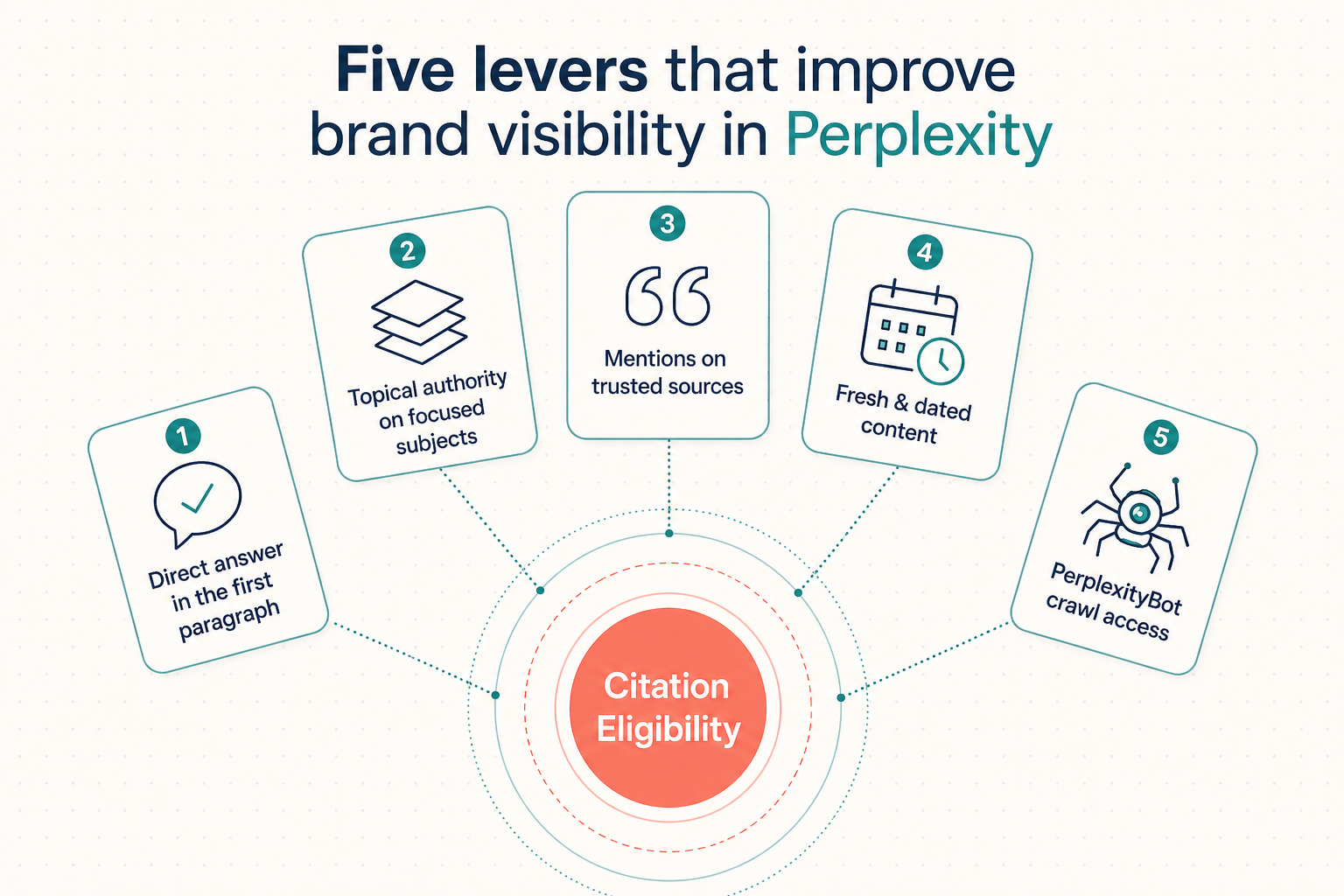
Perplexity's language model scans pages quickly to find a clear, extractable answer to the underlying query. Long introductions, brand storytelling, and throat-clearing reduce the chance of being chosen because the model has to dig past filler to find the answer it can use.
The pattern that works is simple. Open with a one-sentence definition or direct answer. Follow with a paragraph that adds the necessary context — who it is for, when it applies, what to watch out for. Then go deeper through the rest of the article. The opening 100 words should be able to stand alone as a useful answer to the title query.
Perplexity weighs topical depth heavily. A site that publishes 30 well-structured articles on a focused subject tends to be cited more often than a generalist site of similar size that covers everything. Niche depth beats raw domain authority for queries inside that niche.
To build it, pick a small number of subject areas you genuinely want to be known for. Publish pillar pages, supporting explainers, comparisons, and original takes inside each one. Internally link them so the relationships are obvious to crawlers. Over time, the site accumulates entity associations that AI engines recognize.
Perplexity does not just read your site. It reads the wider web — and certain source types punch above their weight. Reddit threads, YouTube videos, well-moderated industry forums, recognized publications, and structured directories show up frequently in citations because they carry strong human-validation signals.
The implication for content and PR teams is that distribution is part of optimization. Contribute usefully to the communities where your audience is already asking questions. Publish or contribute to YouTube content for topics where video answers are common. Build relationships with editorial sites and analysts in your space. When Perplexity assembles its candidate source pool, you want your brand to be visible across more than one surface.
Perplexity heavily filters for recency, especially on topics that change quickly. A page published two years ago, with no visible update date, is more likely to be skipped than a page updated last quarter, even if both contain similar information.
Make the publication date and last-updated date visible on the page. Refresh evergreen content on a quarterly cadence. Update statistics, screenshots, and product references whenever they change. The signal you want to send is "this is current, verified, and safe to cite."
Perplexity uses its own crawler, PerplexityBot, to fetch and read web pages. If your site blocks it through robots.txt, a server rule, or a JavaScript-rendered page that the bot cannot parse, none of the other levers matter — you are invisible to the engine.
The technical checklist is short. Allow PerplexityBot and Perplexity-User in your robots.txt. Make sure critical content renders in server-side HTML, not JavaScript that requires execution to load. Confirm that your site is not behind aggressive bot-blocking rules at the firewall or CDN level. If you want a forward-looking signal, consider publishing an llms.txt file to make your site's structure easier for AI engines to understand.
Structured data — schema markup — gives AI systems a machine-readable description of what a page contains. It does not replace good writing, but it reduces ambiguity, and ambiguity is one of the main reasons a page gets passed over for a citation.
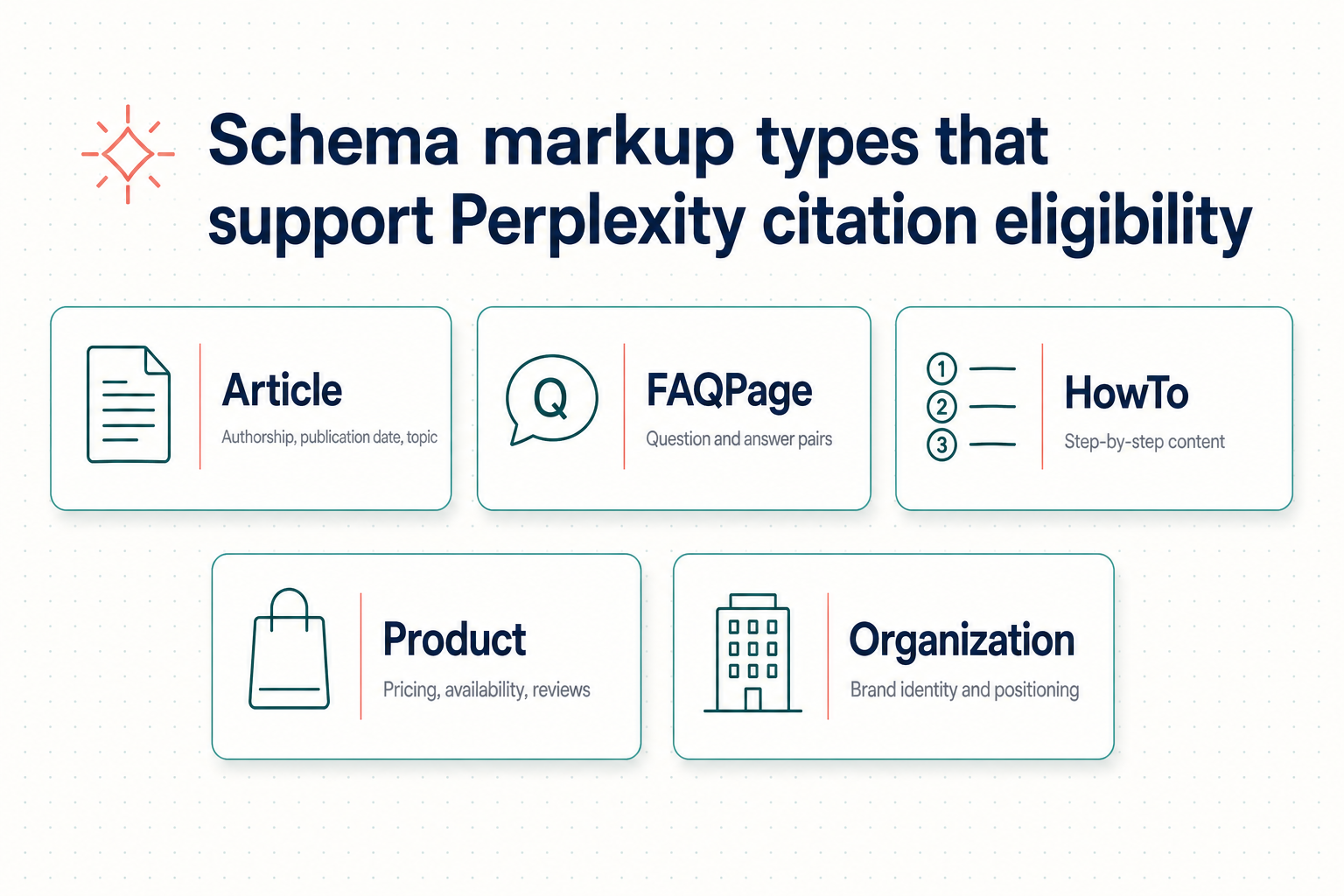
The schema types that support Perplexity visibility are the same ones that support traditional search. Article and NewsArticle clarify authorship, publication date, and topic. FAQPage makes question-answer pairs explicit and easy to extract. HowTo structures step-by-step content. Product clarifies pricing, availability, and reviews for ecommerce queries. Organization describes who you are, where you are located, and how you are positioned. Together, they tell the model what to summarize and how to attribute it.
Implementation should follow Google's structured data guidelines. The same JSON-LD that helps with Google rich results helps with AI citation eligibility, so this is one of the highest-leverage technical investments for a GEO program.
Perplexity's source pool is not the same in every market. The same query asked in the US, the UK, Germany, and Japan can return overlapping but meaningfully different citation lists, because the engine prioritizes language match, regional authority, and locally relevant publishers. A brand that dominates Perplexity in one country may be invisible in another.
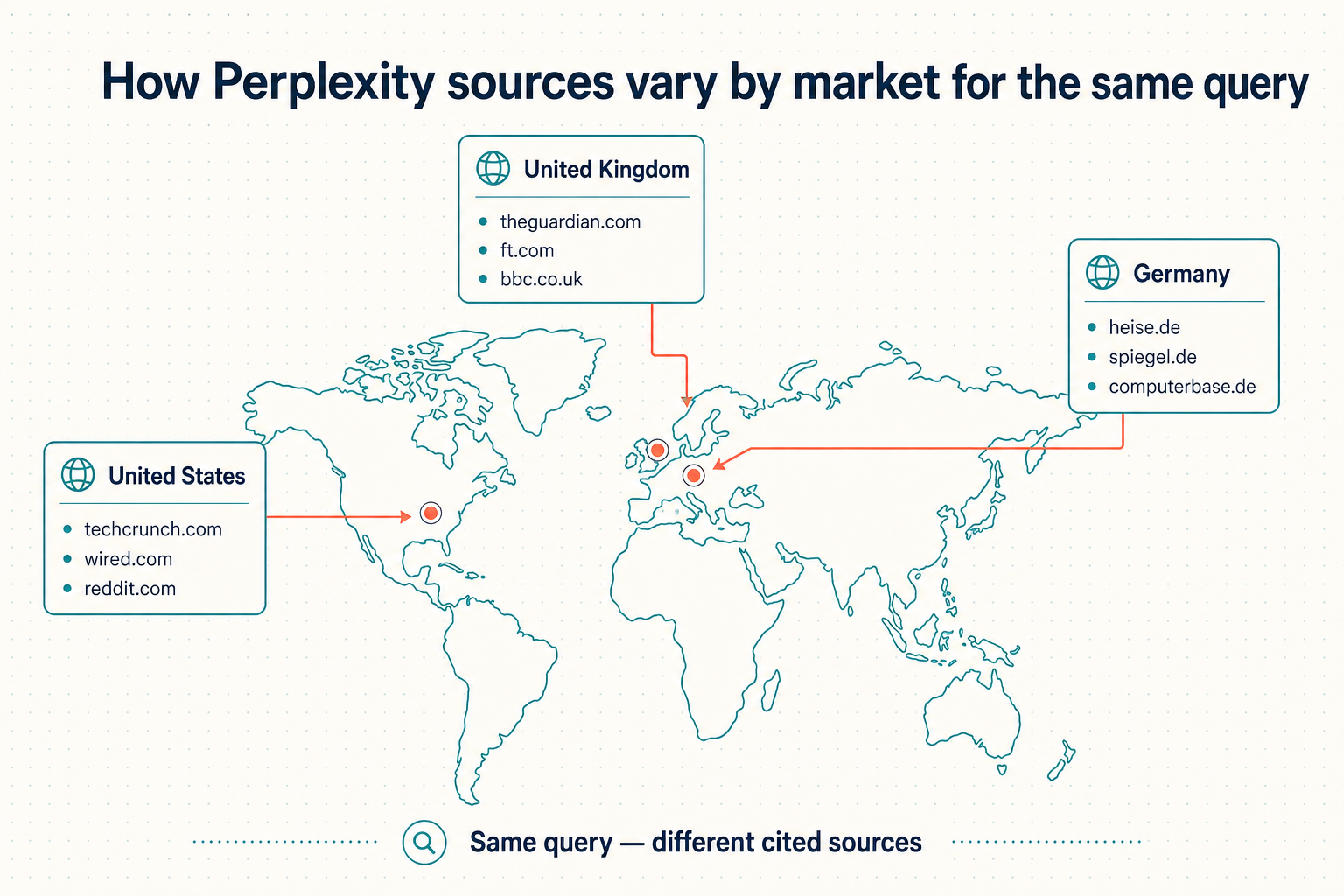
Single-market tracking hides this. It also hides the early signals that matter most — when a competitor starts winning citations in a region you are about to expand into, or when a market shifts toward different source types. A multi-market view is the only way to see the full picture.
This is the layer where dedicated tooling becomes useful. The Perplexity Visibility Tracker at PromptRush monitors citation share, mention rate, source rank, and sentiment across markets and updates over time, so visibility becomes a metric you can manage rather than a snapshot you guess at. The tracking matters less than what you do with it: each market's data should feed into a content and PR plan tuned for that region. If you are still comparing options, the guide to the best Perplexity rank trackers weighs the leading tools on coverage, tracking depth, and price.
Perplexity is one answer engine in a growing set. ChatGPT, Google's Gemini, Google AI Overviews, and Google AI Mode each pull from overlapping but distinct source pools and weight signals slightly differently. A brand with strong Perplexity visibility can still be invisible in ChatGPT, and the inverse is just as common.
Generative engine optimization is the discipline of building visibility across all of these surfaces, and it requires platform-aware measurement. If you are new to the framework, the introduction to GEO explains why this work is separate from traditional SEO and how the metrics differ. Once the framework is in place, platform-specific tracking — with the ChatGPT tracker, the Gemini tracker, and the AI Overview tracker sitting alongside the Perplexity one inside a broader LLM SEO tool — turns Perplexity work into part of a coordinated visibility program rather than a one-off project.
The practical workflow is the same on every engine: monitor where you appear, benchmark against the brands cited alongside you, identify the queries you should win but are not, and use that data to guide content, PR, and structured-data work.
A few patterns consistently hurt Perplexity visibility, and they are easy to fix once you know what to look for.
Fixing these is mostly hygiene work. It will not, on its own, make a brand the most-cited source in a category. It will, however, remove the most common reasons a brand is invisible.
Perplexity reformulates the user's query, retrieves live web pages, ranks candidates by relevance, authority, and freshness, and surfaces a short list as cited source cards. Pages with clear answers, strong topical authority, recent dates, and accessible HTML are most likely to be selected.
There is no fixed timeline because Perplexity retrieves in real time. New or updated pages can be cited within days of publication if they match a query well. Building consistent citation share across a topic usually takes a quarter or more of focused content and authority work.
Yes. Perplexity respects standard robots.txt directives for its PerplexityBot and Perplexity-User user agents. If you block them, your pages will not be retrieved or cited, regardless of how good the content is.
They serve different purposes. Explicit citations drive referral traffic and confer direct credibility. Implicit mentions shape category perception and prompt branded follow-up searches. A complete Perplexity visibility program tracks both as separate metrics.
Google ranks pages in a list and rewards click-through. Perplexity selects a small set of sources to inform a synthesized answer and rewards citation eligibility. The work overlaps — both reward authority, structure, and quality — but the success metric shifts from position to citation share, mention rate, and source rank.
Yes, especially for B2B and considered-purchase categories. Perplexity users tend to be researching decisions rather than browsing, so a citation often reaches a higher-intent reader than an equivalent Google ranking would. Tracking visibility now also builds the baseline you will need as AI search share grows.
Co-Founder & CEO, PromptRush
Rafayel Begoyan is the Co-Founder and CEO of PromptRush. With over a decade of experience in SEO, spanning technical audits, international SEO, content strategy, and organic growth, he now focuses on the intersection of search optimization and AI visibility. Rafayel writes about how brands can adapt to generative search and get discovered in an AI-first world.
View profileGet a free AI visibility report across ChatGPT, Gemini, Perplexity, AI Overviews, and AI Mode. We scan your site and email the results.
Get my visibility reportNo sign-up or credit card required